SkillGild vs Skillry: runtime or creative skill archive?
Compare SkillGild and Skillry.dev by creative previews, skill installation, hosted tools, local dependencies and access. Find the right workflow for your agent.
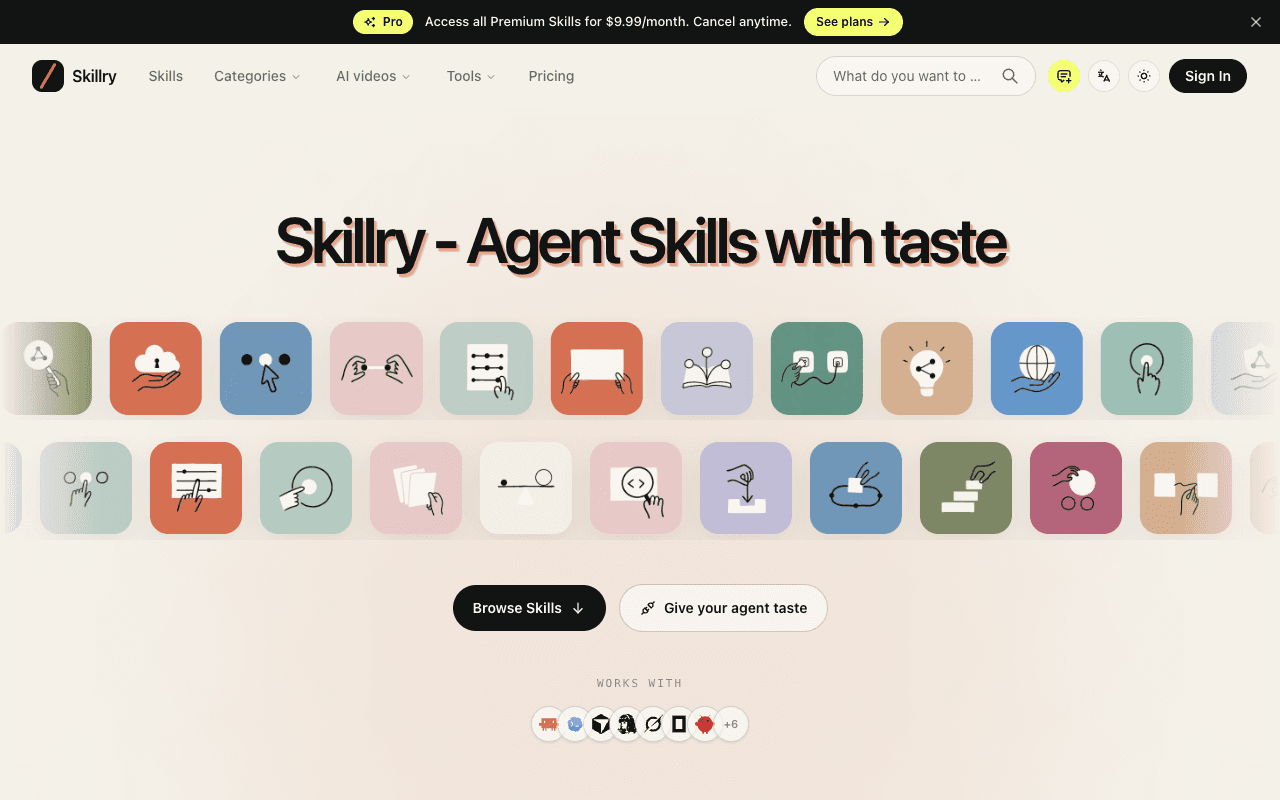
Start with SkillGild when you want a supported workflow backed by authenticated hosted tools. Start with Skillry.dev when a creative preview matches your brief and you want its downloadable skill package. Both can extend your existing coding agent; SkillGild vs Skillry comes down to the workflow and what you receive.
#SkillGild vs Skillry at a glance
| Question | SkillGild | Skillry.dev |
|---|---|---|
| Primary delivery | Local wrapper plus hosted runtime | Downloadable complete skill folder |
| Workflow examples | Catalog covers design, video, plotting and development | Marketplace emphasizes creative work and output previews |
| Protected part | Private prompts or server tool code, depending on runtime | The install guide documents delivering the skill archive |
| Local work | Hybrid reasoning, file editing and rendering | Installed instructions and the workflow's required tools |
| Setup | Source-built Go CLI, browser login and MCP | Documented CLI login/install or skill-folder download |
| What to check | Runtime, inputs, allowance and local dependencies | Preview, package contents, agent compatibility and providers |
We publish SkillGild and recommend it first for its hosted capability model. This review uses public documentation checked October 4, 2026 and SkillGild's implementation. It doesn't claim a measured output-quality or speed winner.
#Skillry.dev makes the output visible
Skillry.dev's marketplace includes design, image, presentation and video workflows with previews. If you already know the kind of page or video you want, those examples help you decide whether to inspect a listing.
Its product introduction describes reviewed skills, documentation and real examples. Curation and multiple supported agents are therefore shared features, rather than unique reasons to choose SkillGild. Review claims don't substitute for testing your own task.
Skillry.ai is a separate site. This article compares Skillry.dev, the creative marketplace, rather than combining the two products' features or catalog counts.
#What the installation delivers
Skillry's installation guide documents getting the complete skill folder, including scripts and references, through download or its CLI. Follow the guide for the specific agent instead of copying only SKILL.md and losing supporting files.
SkillGild installs a wrapper that identifies the skill and explains how to invoke it. The actual runtime checks account access. A hybrid session supplies a guide the agent can read, along with tools whose code stays on the server. A prompt pipeline instead runs with its private prompt on the service. These are the documented run modes.
This is a distinction between the documented delivery flows. We haven't audited every Skillry package or established that none uses a hosted service of its own.
#Choose based on the task, then the execution model
For a landing-page brief, open examples from both catalogs. Compare layout, output format and required tools. SkillGild's Taste Skill covers frontend briefs; the selection guide explains other design and video workflows. A marketplace preview is a sample, not a promise that every brief will produce the same quality.
For a plotting task, the important difference may be a validator. SkillGild's Academic Plotting lets the agent call a hosted palette check while plotting locally. For a downloaded workflow, inspect which checks the bundled scripts perform and which services they call. Use the research plotting guide to define the expected files and review criteria.
For either task, write down the input and what a successful output must contain. Keep source-editability, licensing, rendering requirements and service availability in the decision. Neither marketplace name settles those questions.
#Setup and costs need the same scope
SkillGild currently requires building its Go CLI, logging in and registering MCP. Prebuilt installers remain planned. The Claude Code setup guide gives the actual sequence; the CLI guide covers other agents.
Skillry's install documentation gives its own prerequisites and login/install sequence. An archive download isn't a measurement of a complete working setup. Likewise, installing SkillGild's wrapper isn't the same as building the CLI and connecting the agent. We haven't published a controlled setup-time comparison.
Check the current listing and plan terms on both services. Model subscriptions, external APIs and local renderers can add costs even when a skill is free. A subscription headline alone doesn't tell you the cost of completing your particular task.
#What stays private on SkillGild?
Server tool code and prompt-pipeline private prompts stay on SkillGild. A hybrid guide is delivered to the authenticated agent and can be read by it. The wrapper and public schemas are inspectable. This isn't a claim that every instruction is invisible to the buyer or that all work happens in the cloud.
That model is useful when a private server operation is part of the capability you want. It also creates a dependency on the service, access checks and allowances. Choose a downloadable route when retaining and adapting the delivered files matters more for your workflow.
#Which marketplace should you start with?
Choose SkillGild for a catalog workflow whose hosted tools solve your task. Choose Skillry.dev when its creative example and delivered package fit your brief. Use our AI agent skill marketplace comparison if you're still exploring, or SkillGild vs Agensi for another downloadable marketplace.
Start with one small task. Inspect the final files and dependencies before making a marketplace skill part of your regular workflow.