Monetizing AI Agent Workflows for Developers in 2026
Learn how to turn MCP-compatible agent workflows into revenue streams using hosted skills, specialized logic, and marketplace distribution.

Developers must decide between publishing open-source prompts that users can easily replicate or building hosted Model Context Protocol (MCP) servers that generate recurring revenue. Relying on basic prompt engineering no longer provides a defensible business model in 2026 because generic agents can now replicate text-based workflows with minimal oversight. To effectively monetize ai agent workflows for developers, the focus must shift from writing better instructions to providing reliable execution of complex tasks through specialized tools, high compute, and proprietary data.
This guide establishes the technical and commercial framework for transitioning from simple scripts to professional agentic skills. You will learn to identify which high-value tasks, such as binary reconstruction or SVG generation, are suited for monetization and how to protect your intellectual property by hosting logic on SkillGild’s infrastructure rather than exposing it in a system prompt. By standardizing on the SKILL.md format for cross-client compatibility and selling through existing marketplaces, you can scale from a single script to a tiered subscription model that bills via the per-session pricing structures prevalent.
Key takeaways
- Standardize workflows using the SKILL.md format to ensure compatibility with MCP-enabled clients like Claude Code and Cursor.
- Monetize by hosting high-compute or protected logic on private infrastructure while exposing only the agent interface.
- Focus on niche, high-utility domains like reverse engineering or automated design where generic LLM prompts fail.
- Leverage existing marketplaces to reduce listing time to under 15 minutes and tap into established developer audiences.
Try it on a real task: Academic Plotting is free for 25 runs a month.
#Table of contents
- Monetize workflows by exposing hosted tools via MCP
- Identify when generic prompts fail and specialized skills win
- Host the heavy lifting to protect your intellectual property
- Standardize on SKILL.md for cross-client compatibility
- Leverage existing marketplaces to bypass distribution hurdles
- Use existing marketplaces to bypass distribution hurdles
- Analyze the 2026 landscape of agentic revenue models
- Analyze the 2026 market for agentic revenue models
- Scale your workflow from a single script to a Pro skill
- Frequently asked questions
- Choose Between Building a Tool or Owning a Workflow
#Monetize workflows by exposing hosted tools via MCP
Developers monetize AI workflows by packaging specialized computational logic into Model Context Protocol (MCP) servers. Instead of selling a static prompt, the developer hosts a server that an AI agent connects to via a standardized interface. Access to these hosted tools is governed by API keys, allowing developers to charge based on usage tiers or flat subscription fees. This setup transforms a local script into a cloud-based service that any agentic ecosystem can consume, provided the user has the credentials to call the hosted endpoint.
This approach shifts the commercial value from prompt engineering to reliable execution. Basic reasoning is a commodity provided by the foundational models themselves; the bottleneck for an agent is the inability to interact with proprietary data or perform high-stakes technical operations safely. By exposing a tool through MCP, a developer provides the "hands" for the agent. The monetization model relies on the fact that an agent cannot hallucinate a secure database migration or a complex binary analysis; it must call a trusted tool to perform the task reliably.
Success in this market requires identifying tasks where generic LLM capabilities plateau, such as deep system analysis or specialized hardware interfacing. For those looking to build highly technical servers for security or software analysis, resources like Best Reverse Engineering MCP Servers: Ghidra & IDA provide the blueprint for wrapping complex CLI tools into agent-compatible interfaces. Once the logic is encapsulated, the developer manages the infrastructure, ensuring the tool remains available and performant, which justifies the recurring revenue model.
#Identify when generic prompts fail and specialized skills win
Distinguish between "prompt-based" tasks and "skill-based" workflows to build a sustainable revenue stream. Monetization fails when a workflow relies solely on logic that a user can replicate with a standard system prompt in a frontier model’s chat interface. If a task such as basic markdown formatting or standard code refactoring can be solved by a general-purpose LLM without external assistance, it has become a commodity with zero market value. To charge for an agent workflow, the developer must provide a "skill" that bridges the gap between raw text generation and specialized execution environments.
High-value skills involve tasks that frontier models cannot perform natively due to sandbox limitations or lack of specialized logic. For example, binary reconstruction requires an agent to interact with decompilers and specific architectural knowledge that exceeds the context window’s reasoning capabilities. Similarly, generating precise, mathematically sound geometric logos in SVG format often requires the agent to call external vector libraries or perform high-compute iterations that a standard chat session would timeout on. These workflows succeed commercially because they provide an outcome that the user cannot achieve through simple conversation.
The moat for a monetizable AI agent is built on three pillars: external library integration, high compute requirements, and proprietary data access. When a workflow requires a specific Python environment with non-standard libraries or a connection to a private database, it moves from a "prompt" to a "product." Developers looking to deploy these capabilities should investigate how specialized hosting environments, such as Vercel: Claude Skills and Agent Skills, allow agents to execute complex code outside the restricted chat sandbox. This infrastructure ensures that the developer is selling a functional result rather than a string of text that the user could have generated themselves for free.
Generic workflows fail the monetization test because they lack a technical barrier to entry. If the primary value of an agent is standard natural language generation or basic text synthesis, the developer is competing with the built-in features of every operating system and browser. To win in the 2026 agent economy, focus on specialized niches where the model requires a specific "tool" to be successful. Identifying these failure points in generic models, such as their inability to handle complex file systems or perform deep-packet inspection, reveals the most profitable opportunities for specialized agent development.
| Workflow Type | Monetization Potential | Primary Value Driver |
|---|---|---|
| Standard Code Refactoring | Low | Native LLM reasoning and pattern matching |
| Reverse Engineering Binaries | High | Integration with decompilers and low-level tools |
| Geometric Logo Generation | Medium-High | Math-heavy libraries and iterative SVG rendering |
| Basic Markdown Formatting | Negligible | Standard system prompt instructions |
#Host the heavy lifting to protect your intellectual property
Move your core logic away from the end-user interface to prevent the theft of your intellectual property. The primary barrier to monetizing AI agent workflows remains the vulnerability of prompt logic. When logic resides in a client-side environment or a standard system prompt, it is susceptible to leakage. Once a user or a competitor extracts the specific chain-of-thought instructions or the precise framing that produces high-quality outputs, the developer loses their unique competitive advantage.
Use SkillGild to provide a hosted infrastructure where the "protected prompt" and associated server tools remain strictly server-side. Instead of sending the full instruction set to the local agent, execute the workflow within a secure environment. The local client receives only the necessary responses or function calls, which keeps the underlying architectural complexity and proprietary prompts invisible. This mechanism ensures that the developer’s specialized knowledge is treated as backend code rather than transparent, reproducible text.
Gate your most valuable agent capabilities behind a Pro subscription model by isolating the heavy lifting on remote servers. This infrastructure allows for tiered access where basic agents handle generic tasks locally, while premium, high-reasoning workflows rely on the protected server-side assets. Developers should verify current pricing tiers and specific feature availability on the SkillGild website, as these plans are subject to change. This separation of concerns transforms a simple prompt into a scalable, defensible service.
Adopt Design engineering principles to shift your focus from simple text generation to stable, API-driven agent architectures. Map out which parts of the workflow require the highest degree of protection and host those specific modules as server-side tools. This approach secures the intellectual property and ensures that updates to the core logic can be deployed instantly without requiring client-side updates. These steps maintain the integrity of the monetization strategy.
#Standardize on SKILL.md for cross-client compatibility
Developers must adopt the SKILL.md specification to ensure their workflows operate without interruption across the primary IDEs and command-line interfaces used. This markdown-based configuration file acts as a manifest that allows agents within Claude Code, Cursor, and Gemini CLI to parse and execute complex workflows without manual reconfiguration for each environment. By standardizing on this format, a developer ensures that a single toolset is discoverable by the agent’s internal registry, reducing the friction for end-users who may switch between different AI-powered development environments. Compatibility across these platforms is essential for maximizing the reach of a monetized workflow, as it prevents vendor lock-in and broadens the potential subscriber base.

The SKILL.md file functions by explicitly defining the capabilities, input schemas, and authentication protocols required for the agent to interact with server-side logic. Developers should structure the file to include clear descriptions of each tool’s purpose, as these natural language strings are what the large language model uses to determine when to trigger a specific workflow. The precision of these definitions directly impacts the reliability of the agent; vague descriptions lead to invocation errors or hallucinated parameters. High-quality manifests include example execution traces and error-handling instructions, which guide the agent in recovering from failed API calls without human intervention. This comprehensive documentation within the file transforms a simple script into a professional-grade product ready for commercial deployment.
Before listing a workflow for sale or subscription, developers must verify that the manifest adheres to the latest schema requirements. Using a browser-based validation tool is the most efficient way to catch syntax errors or missing required fields that would otherwise break the workflow in a client’s environment. Developers should use the SKILL.md Checker: Validate Claude & Agent Skills to audit their files for technical compliance and quality scores before proceeding to distribution. This step ensures that the workflow meets the performance benchmarks expected by modern AI agents, providing a stable foundation for the monetization strategies that follow. Validating early prevents the reputational damage associated with shipping broken agent integrations.
#Leverage existing marketplaces to bypass distribution hurdles
#Use existing marketplaces to bypass distribution hurdles
Developers can bypass the overhead of building custom storefronts by deploying agentic workflows directly onto established platforms. Building a proprietary billing and distribution system often delays market entry by months, consuming resources that are better spent on refining agent logic. Instead, publishing to existing ecosystems allows for rapid deployment and immediate access to a global audience. For example, it takes roughly 15 minutes to list a template on the Latenode marketplace, enabling developers to transition from a completed build to a live listing within a single afternoon.
The primary value of an AI agent lies in its underlying logic and the orchestration of specific models, not the interface through which it is sold. Success in the current market demonstrates that specialized, high-utility tools outperform broad, generic agents. Developers should prioritize refining the sequence of prompts, data transformations, and tool-calls within their workflows. By focusing on the "brain" of the agent, creators ensure the product solves a high-value problem, leaving the logistical burden of user management, authentication, and payment processing to the platform provider.
Practical application proves that multi-model integration within niche markets is a viable path to revenue. For instance, VelvetNova built a marketing analytics package that successfully combined three distinct AI models to deliver specialized insights. This approach highlights how developers can monetize complex workflows by targeting narrow industry needs rather than attempting to compete with general-purpose AI assistants. By selling through these marketplaces, developers ensure their niche solutions reach the specific professional audiences that require them without the friction of traditional software distribution.
#Analyze the 2026 landscape of agentic revenue models
#Analyze the 2026 market for agentic revenue models
The shift from per-token billing to outcome-based monetization defines the current developer market. In early 2026, the industry moved away from charging for raw compute volume, recognizing that users value the completion of a complex task over the quantity of processed text. Developers now prioritize "per-session" or "per-result" pricing models, which align revenue directly with the utility provided to the end user. This transition necessitates a move toward hosted skills that can maintain state and execute multi-step logic autonomously. Developers seeking to benchmark these models against high-performing implementations should examine the Best Claude Skills for Research (2026) to understand how top-tier agents structure their value propositions.
This evolution gained momentum following the release of AI Agents: How They Work on January 07, 2026. That foundational analysis clarified how autonomous entities move beyond simple prompt-response cycles to interact with external environments. Since then, the market has matured to favor "success-fee" structures. In these models, a developer might charge a flat fee for a successfully booked travel itinerary or a verified code refactor rather than billing for the thousands of tokens consumed during the agent's iterative reasoning process. This approach mitigates the risk of unpredictable API costs for the consumer while allowing developers to capture a higher margin on efficient workflows.
Adopting a per-result model requires a stable and scalable infrastructure capable of tracking agent performance and verifying outputs. Many developers are migrating their local scripts to managed environments that offer built-in billing telemetry. These platforms often charge a platform fee, typically starting around $20 per month for professional tiers, to handle the orchestration and secure execution of these agentic skills. Developers must confirm current pricing on the vendor’s site. By shifting to hosted skills, developers can provide a more reliable service level agreement (SLA), ensuring that the agent remains available to complete sessions without the latency or connectivity issues inherent in local execution.
#Scale your workflow from a single script to a Pro skill
Begin the transition from a local script to a commercial asset by offering a functional "Lite" version of the workflow. This entry-level tier serves as a lead magnet, allowing users to test the agent’s logic within their own environment without financial commitment. By providing a free tier that supports a limited number of monthly sessions or basic toolsets, you can gather the telemetry needed to refine the agent's decision-making paths. This stage focuses on user acquisition and performance validation. Ensure the workflow processes diverse edge cases without failing before you position it as a premium service.
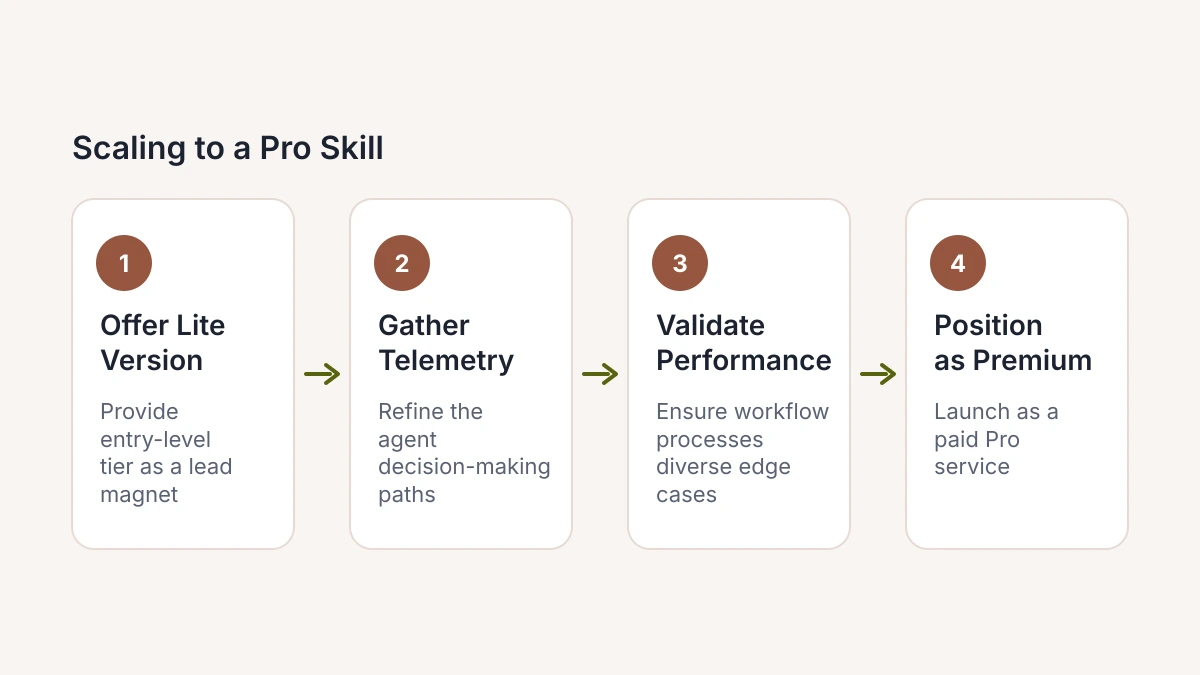
Adoption volume is the primary indicator of a workflow’s market viability. For example, SkyForge88 has sold 14 workflow packages on the Latenode marketplace, proving that even specialized automation scripts generate consistent interest when placed in the right ecosystem. Monitor which specific components of the free tier are triggered most frequently. This usage data identifies the high-value bottlenecks that users are willing to pay to resolve, such as complex data transformations, multi-agent handoffs, or the integration of proprietary data sources that require higher compute resources.
The final step in the roadmap is the introduction of a Pro tier that removes usage caps and unlocks premium capabilities. This tier typically offers unlimited monthly sessions, access to specialized API connectors, and the ability to execute long-running autonomous tasks that would otherwise time out on a standard plan. Structure these offerings around clear professional requirements, including higher execution priority, advanced debugging logs, and enterprise-grade security headers. When finalizing these tiers, check the latest platform documentation to confirm current commission rates and hosting fees. These operational costs dictate the final price point and profit margin of the Pro skill.
#Frequently asked questions
#How do I charge for an MCP server tool?
Integrate a billing layer like Stripe or a marketplace-native payment system directly into your hosted MCP endpoint to verify API keys before execution. By managing the tool on your own infrastructure, you maintain control over access and can implement tiered usage limits based on subscription levels. This setup ensures you capture value every time an agent calls your specific function.
#Can I monetize prompts without exposing the raw text?
Yes, you can monetize prompts by wrapping them within a hosted API or an MCP server where the LLM interaction occurs server-side. Instead of selling the raw text, you sell the output of the workflow, keeping your prompt engineering hidden behind a secure interface. This method ensures users pay for the result without gaining access to your underlying system instructions.
#What is the best pricing model for developer-focused AI agents?
Use a usage-based or credit-based pricing model to align your revenue with the actual value delivered to the developer. Developers generally prefer paying for successful executions or specific tasks rather than flat monthly fees that may not match their consumption. This approach lowers the entry barrier for testing your agent while allowing for uncapped revenue as their automated workflows scale.
#How do I protect my intellectual property in an AI workflow?
Protect your intellectual property by hosting the core logic and proprietary data on your own servers rather than shipping them in client-side scripts. By exposing only the necessary interfaces via MCP or standardized SKILL.md definitions, you keep your specialized algorithms and datasets private. This architecture prevents users from reverse-engineering your workflow or bypassing your monetization strategy by copying the code.
#Choose Between Building a Tool or Owning a Workflow
The transition from writing scripts to monetizing ai agent workflows for developers requires a shift in focus from execution to accessibility. You must now decide if your logic is valuable enough to stand as a paid service or if it serves better as a component of a larger agentic ecosystem. Before committing your code to a marketplace, answer these five questions to ensure your workflow is commercially viable in the 2026 agent economy.
- Isolate the niche, targeting a specific developer pain point where a generic system prompt cannot match the precision of a hard-coded, specialized tool.
- Calculate hosting costs, determining if the projected recurring revenue from your workflow covers the infrastructure required to keep your proprietary logic server-side.
- Check protocol alignment, confirming that your tool’s interface matches the current 2026 requirements for the Model Context Protocol to ensure cross-platform discovery.
- Select your marketplace, deciding whether to prioritize the high volume of a general LLM provider’s store or the higher margins of a specialized developer portal.
- Formalize the skill definition, writing the standardized metadata that allows an autonomous agent to discover and execute your workflow without manual human intervention.
To start monetizing ai agent workflows for developers today, visit Skillgild and register your first hosted tool to begin earning from automated agent calls. Skillgild provides the essential infrastructure to turn your local scripts into globally accessible, revenue-generating agentic skills. Visit https://skillgild.dev/ to launch your first workflow.