How to Navigate the AI Creator Marketplace in 2026
Discover how AI creator marketplaces like SkillGild connect developers with specialized agent skills and workflows using MCP and the SKILL.md format.

Prioritize the selection of an AI creator marketplace that natively supports the Model Context Protocol (MCP) and the SKILL.md documentation standard. This is the most effective first step because it ensures that any capability you acquire, ranging from automated design to reverse engineering, integrates directly into your local developer environment without the need for custom glue code. By focusing on interoperability at the outset, you avoid the technical debt associated with fragmented agent ecosystems that cannot share logic across different platforms.
This guide provides the criteria necessary to distinguish between high-utility hosted infrastructure and low-value prompt libraries. You will be able to decide when to source tools from a public marketplace for rapid scaling and when to deploy a private skill registry to safeguard organizational data. By applying these standards, you can verify the compliance of potential partners against current 2026 data usage regulations and select tools that offer genuine functional advantages over basic LLM outputs.
Key takeaways
- Prioritize marketplaces that use standardized protocols like MCP to ensure your AI skills remain portable across different coding agents.
- Evaluate marketplaces based on their hosting capabilities; look for platforms that handle complex server-side logic rather than just providing prompt templates.
- Monetize reusable workflows by packaging them in the SKILL.md format to reach developers using Claude Code, Cursor, and Gemini CLI.
- Differentiate between simple prompt libraries and true functional skill marketplaces to avoid rebuilding complex integrations from scratch.
Try it on a real task: Academic Plotting is free for 25 runs a month.
#Table of contents
- The AI creator marketplace connects functional agent skills with developer environments
- Standardized formats like SKILL.md prevent fragmented agent ecosystems
- Hosted infrastructure distinguishes functional tools from simple prompt libraries
- Marketplace utility diminishes when local context outweighs specialized logic
- Strategic acquisitions signal the maturation of the AI liquidity layer
- Enterprise adoption requires a clear distinction between public and private skill registries
- Platform longevity depends on maintaining current compliance standards
- Frequently asked questions
- Choosing Between Integration and Autonomy
#The AI creator marketplace connects functional agent skills with developer environments
The AI creator marketplace functions as a central repository for modular agent capabilities. Instead of building every logic chain and API integration from scratch, developers browse these platforms to acquire pre-built, hosted skills that perform specific, high-level tasks. These marketplaces allow engineering teams to outsource the maintenance of complex logic, such as real-time data scraping or specialized compliance checks, to dedicated creators who specialize in those narrow domains. This shift transforms the development process from writing raw code to orchestrating a series of sophisticated, third-party functional blocks.
Integration occurs by embedding these external capabilities directly into an AI agent’s workflow. A developer might source a tool for automated architectural analysis or complex reverse engineering, treating the marketplace as a library of live, executable functions rather than static code snippets. For teams looking to simplify the visual and interactive aspects of their agents, specialized Frontend Design and UI Engineering Skills provide the necessary logic to generate and iterate on user interfaces without manual coding. These hosted skills are maintained by the creator, ensuring the agent always has access to the most current methods and libraries.
The technical bridge between a creator’s hosted logic and a user’s local development environment relies on standardized communication protocols. The Model Context Protocol (MCP) and similar frameworks allow an AI agent to "plug in" to a marketplace skill as if it were a local function. This setup ensures that the specialized logic remains on the creator's infrastructure, where it can be updated, scaled, and optimized, while the execution and output remain accessible within the developer's secure environment. This protocol-based connection eliminates the need for bespoke integration code for every new capability added to an agent's repertoire.
Navigating these platforms effectively requires identifying which functional gaps in an agent's performance can be filled by existing marketplace offerings. By integrating these pre-built skills, developers reduce the time spent on backend infrastructure and focus on the unique orchestration of their specific agent. This shift allows for the rapid assembly of sophisticated AI tools that can interact with file systems, execute code, and perform design tasks through a single, unified interface. The marketplace model ensures that as the underlying AI models evolve, the functional skills they run remain compatible and performant.
#Standardized formats like SKILL.md prevent fragmented agent ecosystems
Use standardized formats like SKILL.md to protect your AI creator business from platform fragmentation. Building specialized tools for a single proprietary environment creates a high risk of obsolescence if that platform changes its API or terms of service. To avoid this, professional creators use SKILL.md as a universal translator. This markdown-based specification ensures that a capability built for one autonomous system can be interpreted and executed by another without manual reconfiguration.
Define a skill’s inputs, outputs, and operational requirements explicitly within a human-readable and machine-parsable document. Do not bury logic inside a black-box prompt or a specific API call. Instead, document the exact parameters the agent needs to provide and the structured data the agent should expect in return. This clarity allows you to define a capability once, establishing a permanent asset that retains its value regardless of which underlying model or orchestration layer is currently dominant.
Enforce compatibility through the Model Context Protocol (MCP). By adhering to the SKILL.md standard, you ensure your tools are instantly discoverable and usable by any agent that supports MCP. This protocol allows the agent to ingest the SKILL.md file, understand the boundaries of the tool, and integrate it into its workflow immediately. This process removes the need for custom wrappers or platform-specific middleware, allowing you to focus on the utility of the tool rather than the plumbing of the integration.
Adopt these standards to prevent the trap of rebuilding from scratch when a platform updates its architecture or a new competitor emerges. You can bundle these standardized capabilities into Agent skill packs and collections to distribute your work across multiple marketplaces simultaneously. This approach ensures that your intellectual property remains portable and functional across the entire 2026 AI ecosystem. By prioritizing interoperability at the start of the development process, you build a resilient portfolio that survives platform volatility and maximizes market reach.
#Hosted infrastructure distinguishes functional tools from simple prompt libraries
Select marketplaces that provide more than just text strings. Prompt engineering remains a core skill, but a repository of system instructions cannot bridge the gap between intent and execution for high-computation workflows. Look past the interface to see where the actual processing occurs to ensure reliable results. If a tool relies entirely on the local LLM’s context window to perform a task, it remains limited by the reasoning capabilities and token limits of that specific model. This limitation often results in hallucinations or structural failures during technical tasks.

Use specialized environments for complex operations such as binary reconstruction or high-fidelity video rendering. A prompt can describe a desired output, but it cannot provide the compilers, rendering engines, or high-memory environments required to generate a functional file. Avoid "video agents" that are merely sets of instructions for a general-purpose model, as the output frequently lacks the structural integrity or resolution necessary for commercial use. These tasks require dedicated environments that exist outside the chat interface and the primary model's weights.
Select tools in the modern ai creator marketplace that use hosted infrastructure to perform the heavy lifting on remote servers. Marketplaces such as SkillGild allow an agent to trigger a remote tool call, which offloads specific technical execution to a specialized server equipped with the necessary software dependencies and hardware. This architecture enables a local LLM to act as a controller while the hosted infrastructure handles the resource-intensive computation. Review the technical documentation provided by the platform for a deeper understanding of how these remote calls are structured and authenticated.
Prioritize tools that provide an API-backed execution layer over those that only provide copy-paste text. When evaluating a marketplace entry, determine if the provider hosts its own compute or if it expects the user to provide the execution environment. High-value agents are those that come pre-wired to functional backends, reducing the friction between the initial prompt and the final deliverable. This distinction ensures that the professional is paying for a functional capability rather than just a well-worded suggestion that may fail under the pressure of a production environment.
#Marketplace utility diminishes when local context outweighs specialized logic
Efficiency in the AI creator marketplace requires identifying when a specialized skill becomes a bottleneck rather than an accelerator. If a task involves highly sensitive proprietary IP or requires processing massive local datasets, the latency and egress costs of an external marketplace agent often negate the benefits of its specialized logic. The overhead of securing a third-party connection and mapping internal schemas to a generic marketplace API can consume more engineering time than executing the task via a standard prompt. Professionals must prioritize data gravity; when the data is too large or too sensitive to move, the logic should be brought to the data rather than the data to the marketplace.
For routine tasks such as generating standard boilerplate code or basic unit tests, a direct prompt to a base LLM is usually the faster path. External skills add a layer of abstraction that is only justified by complex, multi-step reasoning or access to specific third-party integrations. When the requirement is a straightforward translation of business logic into code, the latency of a marketplace call introduces unnecessary friction into the development cycle. Developers who need to determine if a specific workflow justifies an external dependency can explore the Claude Code Skills Marketplace: Install Skills to compare pre-built logic against their current local capabilities.
The specialized nature of marketplace tools becomes a hindrance when the logic is unique to a company’s legacy infrastructure. Many marketplace agents operate on rigid frameworks that expect standardized inputs. If a task requires deep familiarity with a non-standard internal environment, a general-purpose model prompted with local context will often outperform a specialized skill that lacks that specific visibility. Success depends on recognizing that marketplace utility is a trade-off between the depth of the tool’s logic and the friction of providing it with the necessary local context.
| Feature | Marketplace Skill | Local Prompt |
|---|---|---|
| Complexity of Logic | High; designed for specialized, multi-stage workflows. | Variable; limited by the base model's reasoning capacity. |
| Data Privacy Needs | Requires external transit; check vendor terms for data handling. | Data remains within the existing session or local environment. |
| Setup Time | Requires initial authentication and API configuration. | Immediate; relies on the active interface or environment. |
| Specialized Tool Access | Includes pre-wired access to specific third-party platforms. | Limited to general knowledge and local environment tools. |
#Strategic acquisitions signal the maturation of the AI liquidity layer
Marketplace participants must view these platforms as more than simple directories. The sector has evolved into a critical liquidity layer that connects model developers, prompt engineers, and enterprise buyers. This shift from hobbyist experimentation to professional-grade commerce is evidenced by the scale of capital now flowing through these hubs. They act as the settlement layer for AI-driven services, providing the standardized billing and API routing necessary for scalable operations.
The trajectory of the market became clear through high-stakes consolidation. OpenRouter, which Alex Atallah co-founded in 2023, serves as the primary example of this institutionalization. Its transition from a startup to a core component of the global financial ecosystem culminated when Stripe agreed to acquire OpenRouter for a reported $7.5 billion. This move transformed a routing marketplace into a multi-billion dollar infrastructure play, signaling that the industry prizes the transactional "pipes" of the AI economy as much as the models themselves.
For the strategic creator or enterprise buyer, this maturation means the ai creator marketplace is now a stable environment for long-term investment. When selecting a platform, prioritize those with deep integration into existing financial stacks and APIs capable of handling high-volume traffic without failure. The entry of major payment processors indicates that the technical risk of these marketplaces has decreased, replaced by a focus on reliability and legal compliance. Professionals should evaluate these platforms not just for their current inventory of agents or prompts, but for their ability to serve as a durable foundation for automated business workflows.
#Enterprise adoption requires a clear distinction between public and private skill registries
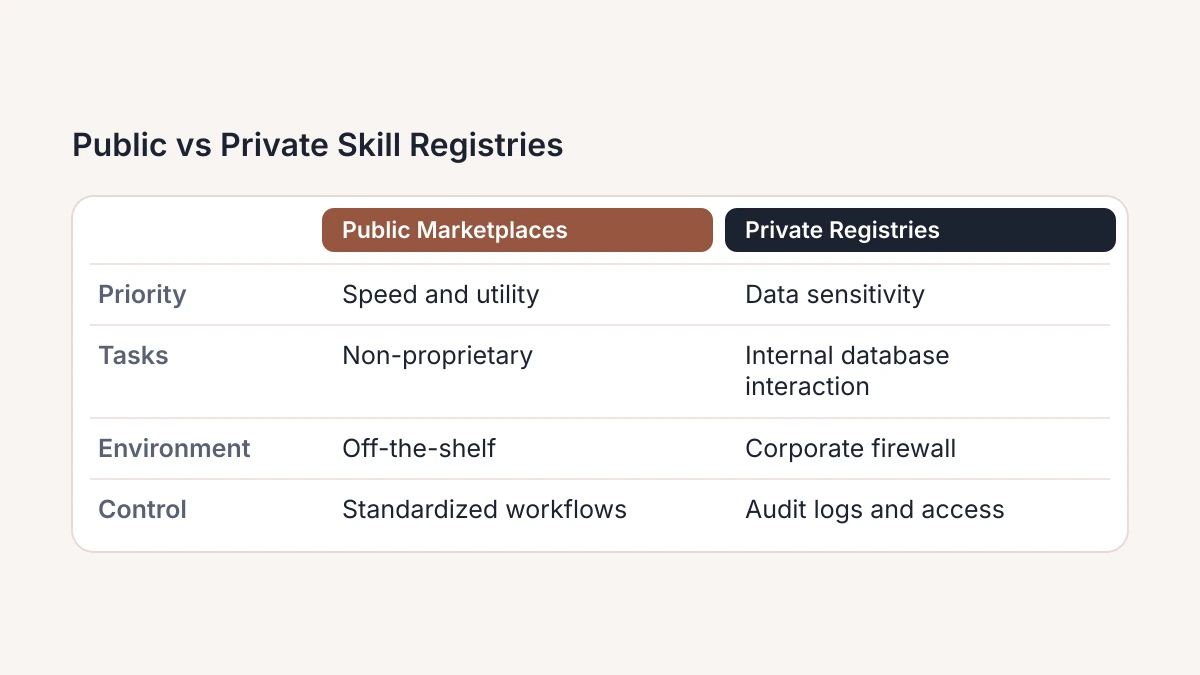
Organizations must determine the deployment environment based on the sensitivity of the data being processed and the urgency of the integration. Public marketplaces serve teams prioritizing speed and off-the-shelf utility. These platforms allow for the immediate procurement of standardized AI agents and workflows that handle non-proprietary tasks, such as general research or public-facing content generation. Conversely, a private organizational registry is necessary when the AI skill must interact with internal databases or sensitive client information. Using a private registry ensures that the logic and the data stay within the corporate firewall, providing a controlled environment for audit logs and access management.
The choice shifts toward hosted marketplaces when a skill relies on "protected prompts" or proprietary API keys. Credential leakage remains a primary risk for creators who distribute specialized tools. If an AI agent requires a specific, high-cost API subscription or a complex prompt structure that constitutes the creator's intellectual property, a hosted marketplace acts as a secure intermediary. These platforms execute the skill on their own infrastructure, passing the output to the user without exposing the underlying instructions or the authentication headers. Professionals should opt for this route to safeguard their operational secrets while still benefiting from third-party innovation.
To act on this distinction, evaluate the specific dependencies of the AI skill before purchase. Review the technical requirements to see if the tool requires a direct connection to an internal API or if it operates as a self-contained service. If the vendor lists a subscription tier that includes private deployment options, users should confirm the exact security features and pricing on the vendor’s current pricing page, as these terms are subject to frequent updates. Selecting the wrong registry type can result in either a bottleneck for innovation or an exposure of internal credentials, making this initial classification a critical step in the procurement process.
#Platform longevity depends on maintaining current compliance standards
Audit a platform’s public compliance documentation against 2026 regulatory requirements to verify the legitimacy of an AI creator marketplace. Select platforms that strictly adhere to updated copyright frameworks and granular data usage standards to protect your intellectual property. Identify explicit disclosures regarding model training sources and opt-out mechanisms for proprietary code before committing to a service. Reject marketplaces that fail to provide these certifications, as they risk sudden de-listing or legal intervention that disrupts deployed services. Confirm these details on the provider's legal or terms of service page, as compliance status can shift following quarterly audits.
Monitor underlying infrastructure providers to ensure sustained participation in these ecosystems. Review the 2026 Google LLC copyright status to understand the specific statutory obligations and court precedents that major tech entities must navigate to maintain service continuity. Prioritize platforms capable of pivoting as data privacy laws evolve, as user volume no longer guarantees marketplace longevity. Use the tactical framework in Monetizing AI Agent Workflows for Developers in 2026 to establish sustainable revenue models and long-term planning. Align with platforms that prioritize these standards to ensure your portfolio remains accessible and legally defensible.
#Frequently asked questions
#What is an AI creator marketplace?
An AI creator marketplace is a platform that connects functional agent skills with developer environments through standardized integration formats. Beyond simple discovery, these marketplaces provide the infrastructure needed to execute complex logic across different LLM providers. They serve as the primary distribution layer for developers looking to outsource specific agentic capabilities without building from scratch.
#How do I monetize my AI agent workflows?
Monetize your AI agent workflows by listing specialized skills on a marketplace using standardized formats like SKILL.md to ensure cross-platform compatibility. You can generate revenue through per-invocation fees or tiered subscription models for access to your hosted infrastructure. Focus on solving high-value enterprise problems where specialized logic is more valuable than generic prompt engineering.
#What is the difference between an AI marketplace and a prompt library?
An AI creator marketplace provides hosted infrastructure and functional tools, whereas a prompt library only offers static text templates. While libraries require you to manage the execution environment yourself, marketplaces handle the compute, state management, and API authentication necessary for an agent to perform actions. This distinction ensures that marketplace skills are ready for immediate deployment into production workflows.
#Can I use AI creator marketplace skills in Cursor or Claude Code?
You can use marketplace skills in Cursor or Claude Code if the skill is exported via a supported integration protocol. Most 2026 marketplaces allow you to bridge hosted agent functions into these IDEs by providing a connection URL or a standardized configuration file. This allows your coding assistant to trigger complex external workflows directly from your local development environment.
#How does the Model Context Protocol (MCP) affect AI marketplaces?
The Model Context Protocol (MCP) serves as the universal bridge that allows marketplace skills to interact securely with your local data and tools. It standardizes how agents request context, making it easier to swap between different marketplace providers without rewriting your integration logic. By using MCP-compliant marketplaces, you ensure that specialized agent logic can access your private files safely.
#Choosing Between Integration and Autonomy
The rapid expansion of the ai creator marketplace has transitioned the industry from experimental prompt engineering to a rigorous exchange of functional agent capabilities. As specialized logic becomes a liquid asset, the decision to adopt a specific marketplace depends on whether your operational bottlenecks are caused by a lack of reasoning patterns or a lack of standardized execution environments. Selecting a provider requires a shift from viewing AI as a monolithic service to treating it as a modular assembly of skills that must be vetted for both performance and portability.
- Define operational boundaries: distinguish between tasks requiring local data context and those needing generalized functional logic.
- Verify standard adherence: check if the skill registry uses the SKILL.md format to ensure portability across different developer environments.
- Audit execution layers: confirm the marketplace hosts the underlying infrastructure required to run the agents rather than just providing prompt templates.
- Evaluate security protocols: determine if the specific skill requires a private registry to maintain compliance with current 2026 data sovereignty laws.
- Measure integration costs: calculate the overhead of connecting third-party agent skills to your existing enterprise middleware.
Prioritize interoperability over immediate convenience to prevent your agent architecture from becoming a collection of disconnected and unmanageable silos. Skillgild provides the necessary infrastructure to build, test, and deploy standardized AI agent skills across diverse platforms. Visit https://skillgild.dev/ to index your first functional skill today.