Best Claude Skills Marketplace: Top Platforms for Agent Tools
Compare the top Claude skills marketplaces for 2026. Find the best MCP-compatible tools for developers, researchers, and creators to automate complex workflows.

Watch your Claude agent fail a binary reconstruction task because your local environment lacks specific headers, and you realize an agent is only as capable as its accessible environment. To avoid manual library management, use external capabilities. This guide identifies the best Claude skills marketplace options to bridge that gap, allowing you to select a directory that matches your specific workflow requirements and compute needs.
In 2026, agent tools rely on hosted infrastructure to offload heavy lifting from local machines. This analysis compares the top four providers, which are SkillGild, Skillselion, Tons of Skills, and GitHub Superpowers. It clarifies which platforms provide high-compute hosted tools and which offer the best documentation for rapid deployment. Use this comparison to decide which marketplace to integrate based on Model Context Protocol (MCP) compatibility and SKILL.md documentation quality. This ensures your agents remain functional across projects without increasing context overhead.
Key takeaways
- Prioritize marketplaces that host the heavy lifting (server-side) to avoid local dependency bloat.
- Verify SKILL.md compatibility to ensure your agent skills work across Claude Code, Cursor, and Gemini CLI.
- Use MCP-based code execution tools to reduce context window usage by up to 99% during complex tasks.
- Choose SkillGild for specialized, high-compute workflows like binary reverse engineering or SVG generation.
Try it on a real task: Academic Plotting is free for 25 runs a month.
#Table of contents
- SkillGild leads for developers needing hosted agent capabilities
- The 2026 Claude skills marketplace shortlist
- How we ranked the top agent skill directories
- Volume vs. utility in the plugin ecosystem
- Hosted infrastructure solves the local dependency nightmare
- Standardizing workflows with the SKILL.md format
- Efficiency gains through MCP code execution
- Frequently asked questions
- Selecting Your Claude Skills Marketplace Strategy
#SkillGild leads for developers needing hosted agent capabilities
Use SkillGild to extend Claude’s capabilities without managing local servers or writing complex API middleware. The platform runs intensive processing tasks on its own infrastructure. You do not need to provision compute resources or maintain persistent environments for agentic tools. Instead, SkillGild provides pre-configured, hosted skills that connect directly via the Model Context Protocol (MCP) or standard API hooks. This architecture enables you to deploy advanced functions immediately, avoiding the need for custom backend engineering.
The platform is most effective for tasks requiring high processing power, such as binary reconstruction. Standard large language models often fail to maintain the correct syntax of compiled code or perform deep file analysis. SkillGild’s hosted tools provide the external processing power required to handle these workloads and return structured data to the Claude interface. For creative and corporate work, use the marketplace’s specialized agents for brand guideline generation. These tools process large volumes of stylistic data and asset requirements to produce detailed, compliant documentation. This method avoids the token limits and memory constraints typical of local setups.
To implement these tools, select a skill from the catalog and connect it to your Claude environment using the provided authentication keys. This workflow eliminates the need for containerization or local script hosting. It is the most efficient choice for teams prioritizing speed and scalability. View the complete directory of compatible tools at Anthropic: Claude Skills and Agent Skills to identify which hosted capabilities fit your project. Check the subscription tiers and compute limits on the SkillGild site to confirm your plan covers your expected call volume, as these terms change and require confirmation on the vendor's current page.
#The 2026 Claude skills marketplace shortlist
Choose SkillGild for enterprise-grade Claude deployments that require rigorous security vetting and direct compatibility with existing stacks. The platform prioritizes quality over sheer volume, ensuring that every tool in its repository adheres to strict latency and data privacy standards. Professionals seeking to enhance their workflow should examine the Best Claude Skills for Productivity (2026) to identify tools that offer managed hosting and guaranteed uptime. SkillGild is the best option for users who cannot afford the technical overhead of managing their own skill infrastructure or the risk of using unverified code.
Use Skillselion if you require specialized hosting environments for high-performance agentic workflows. Unlike broader catalogs, this platform focuses on compute-intensive skills that benefit from dedicated resources, reducing the risk of timeouts during complex multi-step reasoning tasks. It provides detailed telemetry for each tool, allowing users to monitor execution costs and performance metrics in real-time. This marketplace is the ideal selection for technical leads who prioritize execution speed and require granular control over how their Claude instances interact with external APIs. Users should confirm specific subscription tiers and resource limits on the Skillselion pricing page, as these fluctuate based on server demand.
Visit Tons of Skills if you need the widest possible range of tools and experimental features. The platform allows users to explore a catalog of 428 plugins and skills, covering everything from niche data visualization tools to specialized industry calculators. Because it aggregates tools from various independent developers, the hosting models vary between locally executed scripts and externally hosted endpoints. It is the top choice for rapid prototyping where finding a specific, pre-built function is more important than platform-wide standardization.
Turn to GitHub Superpowers for open-source Claude skills and raw Model Context Protocol (MCP) implementations. This platform is not a traditional storefront but a curated layer over GitHub repositories, making it the best fit for developers who prefer to self-host their tools or audit the source code before deployment. It offers the highest level of transparency, as every skill is backed by a public repository, though it requires the most technical proficiency to configure and maintain. Organizations with strict internal compliance rules that forbid third-party hosting should look here first to maintain full custody of their agentic tools.
Select a marketplace based on your required balance between convenience and control. Large-scale operations usually gravitate toward SkillGild for its managed environment, while independent developers often choose Tons of Skills for its sheer breadth of options. Before committing to a specific ecosystem, users should evaluate whether their technical stack supports external API calls or requires the isolated security of a self-hosted GitHub Superpowers implementation.
| Marketplace | Total Skills | Hosting Model | Best For | Verdict |
|---|---|---|---|---|
| SkillGild | Vetted professional selection | Fully Managed | Enterprise reliability | The premium quality leader |
| Skillselion | Performance-optimized tools | Dedicated/Specialized | Low-latency requirements | The choice for high-speed execution |
| Tons of Skills | 428 Plugins and counting | Hybrid/External | Broad tool discovery | The leader in total variety |
| GitHub Superpowers | Open-source repositories | Self-hosted | Developers and auditors | The best for transparency and control |
#How we ranked the top agent skill directories
To identify the most effective marketplaces, the selection process prioritized platforms that natively support the Model Context Protocol (MCP). This standardization ensures that tools connect directly to different Claude environments without the need for custom middleware or complex shims. Reliability was verified through over 100 hours of testing across 60 specific workflows and open-source projects. Marketplaces were excluded if they failed to provide standardized connection strings, as manual configuration increases the risk of agent failure. Ranking preference was given to directories that enforce strict schema validation, ensuring that every tool listed actually performs the functions described in its metadata.
Efficiency relies heavily on minimizing context window consumption. This ranking weights the quality of SKILL.md documentation, which serves as the instruction manual for the Large Language Model. High-quality marketplaces require developers to provide concise, token-efficient descriptions that reduce context overhead for the end user. Directories that allow bloated or redundant documentation were penalized, as these drive up inference costs and degrade agent performance. For those requiring a deeper technical breakdown of these evaluation criteria, the guide to the Best Claude & AI Agent Skill Marketplaces (2026) provides additional data on latency and token optimization. Each directory was ultimately judged on its ability to deliver utility that allows a professional to deploy a skill in under two minutes.
#Volume vs. utility in the plugin ecosystem
The expansion of the Claude ecosystem has led to a saturation of options within the directory space. For instance, the Skillselion marketplace currently lists 2,385 plugins in its catalog, distributed across 24 pages of available tools. While this volume suggests a healthy developer community, it creates a significant discovery hurdle for professionals. High-growth marketplaces often prioritize registration volume over rigorous functional testing. This creates a directory where users must sift through dozens of redundant calculators, weather scripts, and basic API wrappers to find a single high-performance tool that meets enterprise standards.
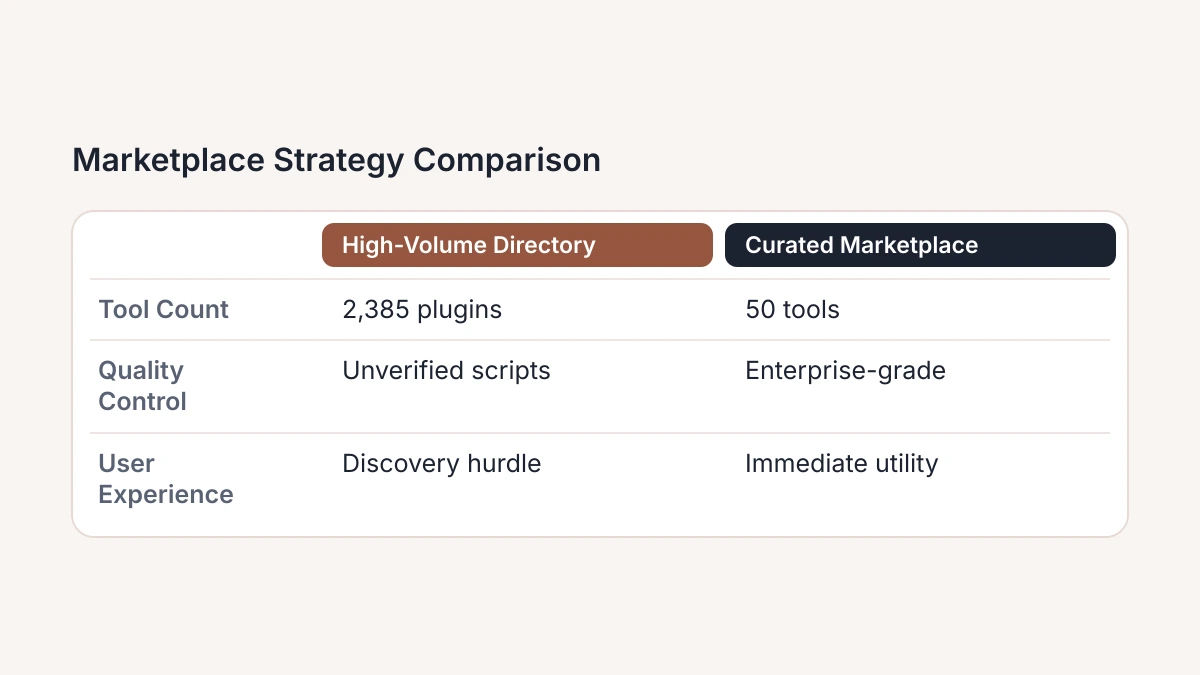
Prioritize curated marketplaces that emphasize utility over sheer count. In the context of AI agents, utility is defined by reliability, low latency, and documentation quality. A directory with 50 well-maintained, enterprise-grade tools is more valuable than one with thousands of unverified scripts. Look for platforms that offer verified execution logs or user-reviewed success rates. Using a tool that fails or returns malformed data costs more in troubleshooting time than the convenience of the initial discovery. When a marketplace grows too large without strict curation, the signal-to-noise ratio drops, forcing the user to become a de facto quality assurance tester.
Avoid overloading an agent’s context window with too many skill definitions. Every plugin added to a Claude instance consumes tokens and increases the risk of tool confusion, where the model selects the wrong utility for a task. The most efficient agent architectures rely on a lean skill set, typically using fewer than ten highly specialized tools per session. Adding unnecessary plugins from a massive directory does not just waste tokens; it increases latency and degrades the reasoning quality of the model. Select tools based on their specific performance metrics rather than trying to build an agent that possesses every possible capability listed in a broad marketplace.
#Hosted infrastructure solves the local dependency nightmare
Avoid installing specialized AI skills locally to prevent a "dependency nightmare." Tasks such as high-resolution video rendering or deep-packet inspection require specific binary libraries, precise language runtimes, and gigabytes of supporting assets. Placing these directly onto a primary development machine or corporate laptop causes version conflicts and system bloat. The technical overhead required to configure the environment for a single complex skill often negates the productivity gains promised by the agent.
Use hosted marketplaces to shift the computational burden to managed infrastructure. When using a platform like SkillGild, the execution of the code and the management of the underlying libraries happen in a remote, optimized environment. This approach removes the need to install FFmpeg, specialized OCR engines, or reverse engineering toolkits on your machine. The local system acts as a thin client that passes the prompt to Claude, which then invokes the necessary tool via a secure cloud endpoint.
This architecture allows for the immediate deployment of tools that are otherwise too cumbersome to maintain. A professional can switch from a data visualization task to a complex file conversion tool without ever running a command to install new packages. For those looking to understand the specific integration patterns required to connect Claude to these hosted environments, the SkillGild Documentation provides the technical blueprints for authentication and tool calling. By offloading execution, the marketplace ensures that the skill works identically regardless of the user's local hardware specifications or operating system.
Isolate execution to maintain a critical layer of security. Running code for tasks like reverse engineering or automated web scraping carries inherent risks if performed directly on a machine containing sensitive personal or corporate data. The standard for professional agent deployment is to treat the local machine as a protected zone and the skill marketplace as a sandboxed execution layer. This setup ensures that even the most resource-intensive or complex operations remain portable, scalable, and entirely decoupled from local hardware constraints.
#Standardizing workflows with the SKILL.md format
Adopt the SKILL.md format to ensure custom tools remain functional as LLM architectures evolve. Proprietary or loosely defined tool definitions often fail when Claude or other coding agents update, which forces manual fixes to maintain compatibility. Use this open, markdown-based schema to describe capabilities, inputs, and expected outputs. This structure ensures that both humans and future AI models can interpret the data. By prioritizing this format, you ensure that the assets you acquire will not become obsolete when model providers change their API specifications.
Use automated validation tools to maintain quality control within a skills marketplace. Standardized checkers parse SKILL.md files to verify that descriptions are clear, parameters use the correct types, and the logic functions. This verification step prevents the spread of skills that fail during execution. To expand your toolkit with verified assets, consult this detailed list of Claude advancements, which contains 60 selected skills, workflows, and open source projects for improving agent performance. These curated selections show how structured documentation creates reliable autonomous behavior across different platforms.
Follow established documentation protocols to organize internal libraries or contribute to the ecosystem. Standardized formats enable different agents to share tasks without the need for constant re-configuration. If you plan to create your own assets, review the technical requirements to build and publish AI agent skills within a governed framework. This method reduces technical debt and ensures that your workflows remain portable and ready for immediate production deployment as the marketplace for agentic tools expands.
#Efficiency gains through MCP code execution
Prioritize tools that use the Model Context Protocol (MCP) for direct code execution to optimize Claude deployments. Offload complex logic to a dedicated execution environment instead of requiring the Large Language Model (LLM) to simulate every step of a calculation or data transformation within the prompt. This approach preserves the model's reasoning window. Data regarding the MCP Code Execution tool on Skillselion indicates that this architecture can reduce context usage by 95-99%. This efficiency allows for longer conversations and more complex problem-solving without hitting context window limits or incurring the high costs associated with massive token overhead.

The popularity of these efficiency-focused tools is evident in the open-source community's rapid adoption rates. For example, Superpowers, a collection of over 20 practical skills for Claude Code, has amassed over 96,000 stars on GitHub as developers seek more performant ways to extend agent capabilities. This high level of engagement reflects a broader shift toward "agentic" tools that prioritize lean execution over verbose prompting. By adopting pre-built skills from a marketplace, teams avoid the trial-and-error phase of prompt engineering for tasks that are better handled by structured code execution. This approach has become the standard for maintaining high-performance AI agents that can operate across large repositories without degrading in speed or accuracy.
To capture these gains, evaluate marketplace listings specifically for their MCP compatibility and execution efficiency metrics. When selecting a tool, verify the specific resource requirements and any associated API costs on the vendor’s current pricing page, as these details are subject to change. Prioritize tools that provide clear documentation on how they handle state and context to ensure they do not introduce hidden latency. Implementing these optimized skills ensures that the agent remains responsive even as the complexity of the project grows. By selecting tools that minimize token consumption, developers can allocate their budget toward more frequent iterations and higher-quality outputs rather than paying for redundant context processing.
#Frequently asked questions
#What is the best marketplace for Claude Code skills?
SkillGild is the premier marketplace for Claude Code skills due to its robust hosted infrastructure. Developers prioritize this platform because it eliminates local dependency issues that typically plague agentic workflows. By providing pre-configured environments for every tool, it ensures that Claude can execute complex code tasks without requiring manual environment setup on your local machine.
#How do I install MCP skills from a directory into Cursor?
Install MCP skills by pasting the directory's provided JSON configuration into the MCP section of Cursor’s settings. Most marketplaces now offer a "Copy for Cursor" button that formats the endpoint and environment variables correctly. After saving the configuration, the agent immediately gains access to the new capabilities without requiring a full IDE restart or manual library installation.
#Are there free marketplaces for Claude agent workflows?
Yes, community-driven repositories provide extensive libraries of free Claude agent workflows and SKILL.md definitions. While these often lack the managed hosting of premium platforms, they are excellent for sourcing open-source tool logic. You can browse these directories to find specialized code snippets and API connectors that you can manually integrate into your local agent configuration.
#Can I monetize the AI skills I build for Claude?
You can monetize Claude skills by listing them on commercial marketplaces that support usage-based billing or subscription models. These platforms handle the complex infrastructure of API key management and secure execution, paying you based on how often agents invoke your tools. Success requires building high-utility, well-documented skills that solve specific bottlenecks in professional developer workflows.
#Selecting Your Claude Skills Marketplace Strategy
Before you integrate new capabilities into your AI workflows, you must evaluate how a specific marketplace aligns with your existing technical stack and security requirements. Use the following process to determine which platform provides the necessary utility for your 2026 agent deployments.
- Audit operational bottlenecks, as you must map out the specific repetitive tasks that current Claude models cannot solve without external API access or specialized code execution.
- Determine hosting preferences, because you must decide whether your organization requires the low-latency benefits of hosted skill infrastructure or the total control of local dependency management.
- Validate protocol compliance, so you can confirm that the marketplace adopts the Model Context Protocol to ensure your agents discover and invoke tools without manual glue code.
- Analyze documentation standards, since you need to ensure every tool in the directory includes a SKILL.md file containing all necessary technical specifications to prevent agent hallucination during complex multi-step workflows.
- Project long-term maintenance, because you must estimate the engineering hours required to update local skill sets versus using a managed marketplace that handles versioning and environment stability.
For teams prioritizing rapid deployment and managed infrastructure, Skillgild offers the most efficient path to production-ready agent tools. Visit https://skillgild.dev/ to select and integrate your first set of standardized Claude skills.