Mastering Software Reverse Engineering for Modern AI Agents
A comprehensive guide to software reverse engineering tools and methodologies for 2026, featuring RevEng.AI and SkillGild agent workflows.

Connect your binary analysis tools directly to LLM-based coding agents using the Model Context Protocol (MCP) to automate the most labor-intensive stages of software reverse engineering. This integration is the primary step because it transforms static, isolated data into actionable context for autonomous workflows. By 2026, the volume of obfuscated code in Electron and Android packages has made manual inspection a bottleneck. Establishing a pipeline where an agent can programmatically query an Intermediate Representation (IR) ensures that logic recovery keeps pace with active development cycles.
This guide provides the framework to select toolkits based on API accessibility and IR quality, ensuring your stack supports automated deconstruction rather than just manual viewing. You will be able to distinguish between the analytical discovery of reverse engineering and the generative transformation of reengineering, allowing you to deploy the right process for the specific technical challenge at hand. Furthermore, you will learn to scale these operations by offloading heavy computation to hosted infrastructure like SkillGild, enabling your coding agents to handle complex deobfuscation and asset extraction without degrading local performance.
Key takeaways
- Prioritize tools that offer MCP compatibility to allow AI agents like Claude Code to interpret binary analysis directly.
- Distinguish between re-engineering for improvement and reverse engineering for understanding to avoid scope creep in legacy projects.
- Use binary-to-intermediate-representation (IR) platforms to bridge the gap between machine code and human-readable logic.
- Leverage hosted agent skills to bypass the hardware-heavy requirements of local deobfuscation and binary reconstruction.
Try it on a real task: Academic Plotting is free for 25 runs a month.
#Table of contents
- Selection Criteria for Modern Reverse Engineering Toolkits
- Top Resources for Automated Binary Analysis and Deconstruction
- Reverse Engineering and Reengineering Serve Different Goals
- Connect Binary Analysis to Agent Workflows via MCP
- Deobfuscate Electron and Android Packages with Specialized Skills
- Scale Analysis by Hosting Protected Prompts and Tools
- Frequently asked questions
- Choosing Between Manual Depth and Agentic Speed
#Selection Criteria for Modern Reverse Engineering Toolkits
Select toolkits based on their API exposure. To ensure an AI agent performs software reverse engineering effectively, choose a toolchain that allows programmatic interaction instead of relying on a graphical user interface. Prioritize frameworks that offer Python or C++ bindings covering the full range of tool functions. These bindings allow the agent to automate renaming functions, tracing cross-references, and analyzing data flow. Avoid tools that lack a stable, crash-resistant headless mode or a well-documented API. Without these, the agent cannot execute the iterative loops required for deep binary inspection.
Evaluate the quality of the Intermediate Representation (IR) as the next step. Since LLMs often struggle with raw assembly across different architectures, choose a toolkit that lifts machine code into a clean, architecture-neutral IR. Select tools that provide multiple IR tiers. These should range from low-level representations for stack analysis to high-level, C-like abstractions for logic recovery. Use a structured and semantic IR to help the LLM-based agent reason about software intent, identify vulnerabilities, or find undocumented features.
Standardize your selection on integration capability via the Model Context Protocol (MCP). Prioritize platforms that support MCP servers to create a direct bridge between the reverse engineering environment and the AI agent’s reasoning engine. This setup lets the agent pull live context from a decompiler and push refactored code or annotations back into the database in real-time. If you need to bridge the gap between technical analysis and deployment, explore Product Launch Skills for AI Coding Agents to ensure automated workflows result in functional software. Check vendor documentation for current API support and plugin compatibility, as these specifications change frequently.
#Top Resources for Automated Binary Analysis and Deconstruction
Use IDA Pro for deep visibility into compiled code. It includes a stable, high-performance debugger and the Hex-Rays decompiler, which converts machine code into a C-like representation for easier human analysis. Extend the tool via its SDK or Python scripting to customize your workflow. Because the entry cost is high and advanced features require significant study, verify current licensing tiers and plugin compatibility on the vendor's site before purchasing.
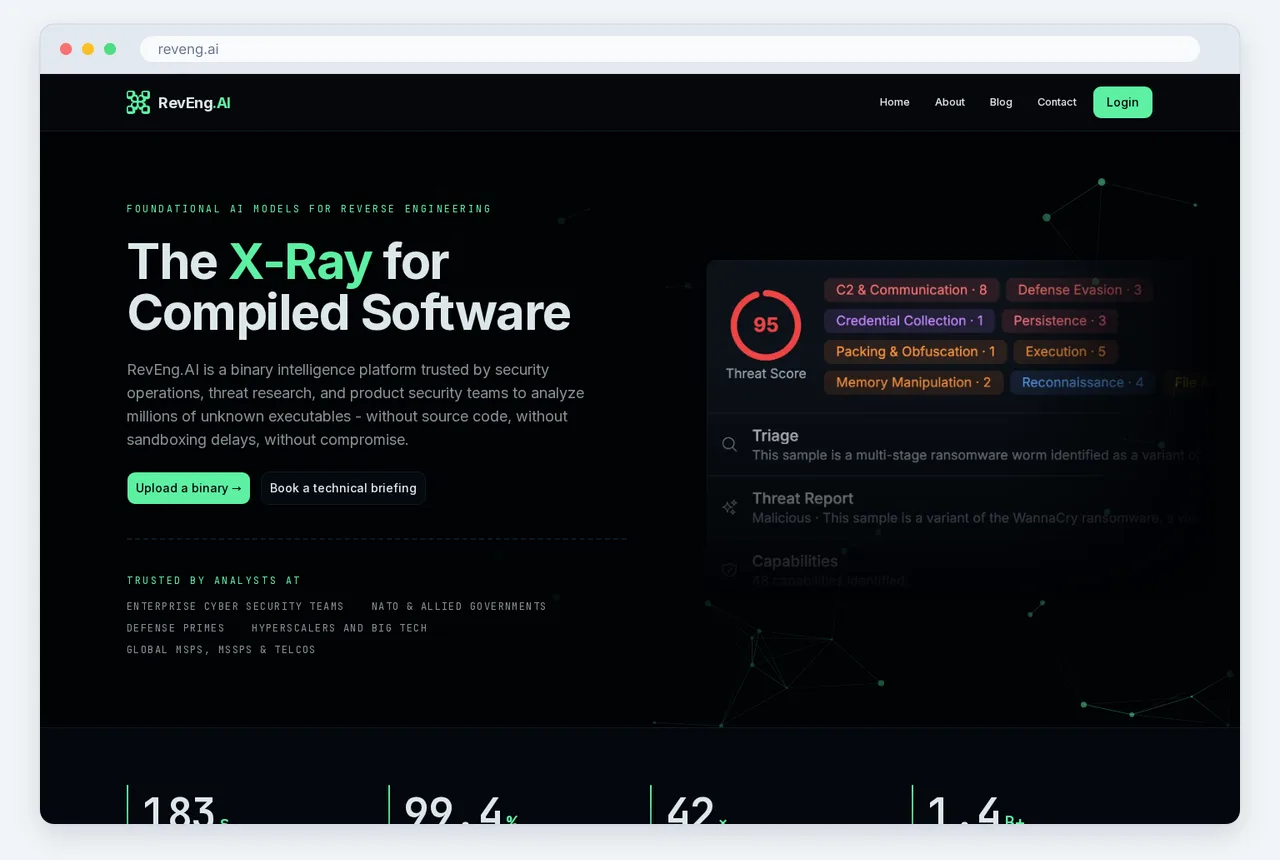
Integrate RevEng.AI into your workflow to identify code patterns across different architectures. This platform uses large-scale machine learning models to search for similar functions across a vast database, reducing the time spent identifying known libraries. Note that highly unique or custom-obfuscated code still requires manual analysis, as the results depend on the specific data used to train the model.
Adopt Ghidra if you need a powerful, open-source tool that supports many processor instruction sets. Developed by the National Security Agency, it provides a decompiler and collaborative analysis features without per-seat licensing costs. Consult the official project documentation to confirm supported architectures. Be aware that the Java-based backend may slow down when analyzing very large binaries, and the interface is less polished than commercial options.
Use Binary Ninja to build automated data pipelines for AI agents or vulnerability scanners. It employs a multi-tier Intermediate Language (IL) to abstract processor-specific instructions into a format suited for automated scripts. Check the vendor's site to compare personal and professional editions. While the decompiler is advanced, it may struggle with legacy code structures that older tools handle more effectively.
Balance manual control with the speed of automated insights. IDA Pro and Ghidra provide visibility for manual reviews, while platforms like RevEng.AI and Binary Ninja offer the data-centric models needed for modern security operations. Prioritize tools with versatile APIs and cross-platform compatibility. For the best results, use automated similarity searches to narrow your scope before performing deep-dive disassembly on critical components.
#Reverse Engineering and Reengineering Serve Different Goals
Use software reverse engineering as an analytical process to extract design information from a finished product. Start with a compiled binary or an opaque system and work backward to identify the original components, logic flows, and data structures. AI agent development, apply this process to understand how legacy software functions when you do not have access to source code. Focus your efforts on the documentation and comprehension of existing behavior, as this is a quest for knowledge rather than a modification of the asset.
Apply reengineering when you need to modify or reconstruct a system to improve its performance, maintainability, or compatibility. While this generative process often uses insights gained from reverse engineering, your primary goal is transformation. Reengineer a system to move it from one architecture to another or to refactor outdated logic into modern microservices. This stage requires active coding and architectural shifts, moving beyond mere observation into the actual work of creation and deployment.
Distinguish between these two methods to maintain technical clarity and legal compliance. Use reverse engineering as a prerequisite for interoperability, allowing an AI agent to interface with a closed system. You must ensure your investigative methods align with the specific Terms of Service governing the target software to avoid breach of contract or intellectual property violations. Do not mistake reengineering for reverse engineering. Doing so leads to scope creep, where the simple need to understand a protocol expands into an unnecessary and risky rewrite of the entire application.
Treat reverse engineering as the diagnostic phase and reengineering as the surgical phase. If you are building AI agents, keep your focus primarily on the former to enable the agent to navigate and manipulate existing environments. By isolating discovery from transformation, you can build stable, highly compatible tools that interact with a wide variety of software ecosystems without the overhead of maintaining a cloned or modified version of every legacy system the agent encounters.
#Connect Binary Analysis to Agent Workflows via MCP
Integrating software reverse engineering into an automated pipeline requires a standardized communication layer between the static analysis engine and the large language model. By adopting the Model Context Protocol (MCP), developers can expose specialized binary analysis tools as callable functions within an agent’s environment. This setup allows an AI agent to query a binary’s structure, identify entry points, or extract metadata without manual intervention. Instead of the developer acting as the middleman who copies assembly snippets into a chat interface, the agent directly interacts with the toolset to pull the necessary context for its task.
SkillGild facilitates this connection by providing pre-built adapters that bridge the gap between heavy-duty static analysis tools and lightweight coding agents. Through these adapters, an agent gains access to 'Reconstruction' skills designed to handle the heavy lifting of code recovery. When an agent encounters a compiled or minified file that exceeds its native reasoning capabilities, it triggers a SkillGild Reconstruction skill. This external process performs the deep analysis, including control flow graph recovery or variable type inference, and returns a structured representation that the agent can actually use to suggest fixes or feature additions.
Developers initiate these workflows directly from their IDE by configuring the agent to recognize the SkillGild MCP server. This allows for the automated deobfuscation of complex binaries during the active development cycle. For those looking to implement these capabilities within specific LLM frameworks, reviewing the integration guides for Anthropic: Claude Skills and Agent Skills provides the necessary technical roadmap. By offloading the computational intensity of software reverse engineering to specialized external skills, the agent maintains high context window efficiency while working on high-level logic.
The workflow concludes with the agent receiving the reconstructed source and integrating it into the local project structure. Because the Reconstruction skill handles the transformation of obfuscated logic into human-readable patterns, the developer spends less time deciphering symbol mangling and more time reviewing the agent’s proposed architectural changes. This automated bridge ensures that legacy or opaque binaries are no longer "black boxes" to the AI, but are instead treated as standard, editable components of the codebase. Developers should verify current subscription tiers and API rate limits on the SkillGild pricing page to ensure their agent's throughput matches their project requirements.
#Deobfuscate Electron and Android Packages with Specialized Skills
Extract the core application files to expose the underlying source structure. For Electron, target the app.asar archive. For Android, locate the classes.dex files. Modern application bundles present a unique challenge for reverse engineering because they rely on high-level languages like JavaScript and Java. Electron applications wrap logic within a Chromium-based environment, while Android APKs run on the Dalvik or ART runtimes. The primary hurdle remains the sheer volume of minified code and obfuscated symbols that obscure the developer's original intent. Unlike compiled C++ binaries, these high-level formats are technically readable but functionally opaque.

Deploy hosted skills to automate the deobfuscation process, which is often too labor-intensive for manual review. Train specialized AI agents to recognize patterns in obfuscated code, such as control-flow flattening or junk code insertion. By processing raw assets through these skills, the agent reconstructs meaningful function names based on API call signatures and internal logic flow. This automation transforms a chaotic wall of minified text into a structured codebase. This allows the professional to focus on high-value logic rather than manual beautification.
Center your analysis of Electron environments on the interaction between the main and renderer processes. Extracting the source is only the initial step. You must identify how the application communicates via Inter-Process Communication (IPC) to map hidden features or security vulnerabilities. Professionals looking to refine this specific workflow can Reverse Engineer an Electron App with AI to master the specialized tooling required for Chromium-based targets. This methodology bridges the gap between raw file extraction and a functional understanding of the application’s architecture.
Convert bytecode back into a human-readable format when analyzing Android packages. While traditional tools provide a foundation for decompilation, hosted skills refine the output by mapping obfuscated classes back to their probable original intent. Cross-reference system-level Android API calls with the application’s unique business logic. By automating this mapping, the AI agent identifies the specific modules responsible for data handling and network requests. This effectively strips away the layers of protection designed to thwart inspection and allows for rapid logic extraction.
#Scale Analysis by Hosting Protected Prompts and Tools
Offload resource-intensive tasks to dedicated hosted infrastructure to prevent latency and timeouts in autonomous AI agents. Software reverse engineering, including code deobfuscation and control flow mapping, creates significant computational overhead. If handled locally, these tasks often exhaust context windows or cause the agent to lag. By moving these processes to a backend environment, the agent acts as a thin-client orchestrator. This setup ensures the agent remains responsive while specialized systems perform the binary analysis.
Connect agents to a hosted platform like SkillGild to delegate static and dynamic analysis to a scalable environment. Decouple the reasoning engine from the analysis tools so the agent can send raw binary data or disassembled code to a remote service. The agent then receives structured intelligence without the massive memory requirements of large-scale software projects. This architectural shift keeps the primary execution loop from throttling during complex analysis.
Secure proprietary heuristics and specialized prompts in a hosted environment to protect intellectual property. Storing the logic for identifying zero-day vulnerabilities or proprietary algorithms locally risks exposure and extraction. By hosting these assets, you ensure that reverse engineering methodologies remain confidential. The agent retrieves results through secure API calls, which keeps the underlying logic hidden from the target environment and the end-user.
Modularize decompiler scripts and signature libraries into independent services to begin this transition. This structure allows you to iterate on reverse engineering tools quickly without redeploying the entire agent framework. For technical specifications on integrating these tools, the Documentation provides detailed instructions on endpoint configuration and data schema. Check the vendor's pricing page to verify current service availability and integration costs against your throughput requirements.
#Frequently asked questions
#Is reengineering and reverse engineering same?
No, they are distinct processes within the software lifecycle. Software reverse engineering focuses on extracting design specifications and logic from a finished product, while reengineering is the subsequent act of transforming or reconstructing that system to improve performance or maintainability. Professionals typically use reverse engineering to map legacy binaries before initiating a reengineering phase to port that logic into agentic frameworks.
#What are the best tools for reverse engineering Electron apps?
Utilize asar utility packages for initial extraction combined with advanced AST-based deobfuscators. Because modern Electron distributions frequently employ V8 snapshots to hide source logic, you must also use specialized memory dumpers to capture the heap and reconstruct the original JavaScript environment. This combination allows you to bypass the Chromium-based packaging and analyze the underlying business logic directly.
#How can I use AI agents to automate binary analysis?
Connect your disassembly tools to an agentic workflow using the Model Context Protocol (MCP). By exposing a decompiler like Ghidra or IDA Pro as a tool within the MCP schema, an AI agent can autonomously navigate function calls and interpret assembly patterns. This allows the agent to perform iterative hypothesis testing on binary behavior, significantly reducing the manual effort required for pattern matching.
#What is the legal boundary for software reverse engineering in interoperability cases?
Software reverse engineering is generally protected when performed solely to achieve interoperability between two independent programs. You must ensure that your analysis does not exceed the scope of identifying functional interfaces and that you are not circumventing digital rights management (DRM) for the purpose of piracy. Always verify that your specific jurisdiction’s fair use or fair dealing exceptions apply to the specific binary you are analyzing.
#Choosing Between Manual Depth and Agentic Speed
To determine the most effective path for your software reverse engineering project, answer these five questions to define your technical requirements:

- Define your objective, determine whether your primary goal is to extract specific hidden API endpoints or to perform a complete architectural recovery of the proprietary binary logic.
- Audit your environment, verify that your infrastructure supports the strict containerized isolation necessary for running 2026-era automated deconstruction tools without compromising your primary host security.
- Assess obfuscation levels, identify if the target application employs standard commercial protectors or bespoke polymorphic code that necessitates the development of custom deobfuscation scripts for your agent.
- Evaluate integration needs, decide if the extracted metadata must be formatted for immediate consumption by a Model Context Protocol server to facilitate real-time autonomous agent responses.
- Quantify resource allocation, calculate the specific GPU and memory overhead required to host the protected prompts and large language models driving your high-scale analysis pipeline.
While automated tools significantly accelerate software reverse engineering, the human element remains the final arbiter of intent and security. Explore the Skillgild curriculum to master these advanced workflows and start building your first autonomous analysis agent today at https://skillgild.dev/.